Mexican Labor and World War II by Erasmo Gamboa Kevin Leonard
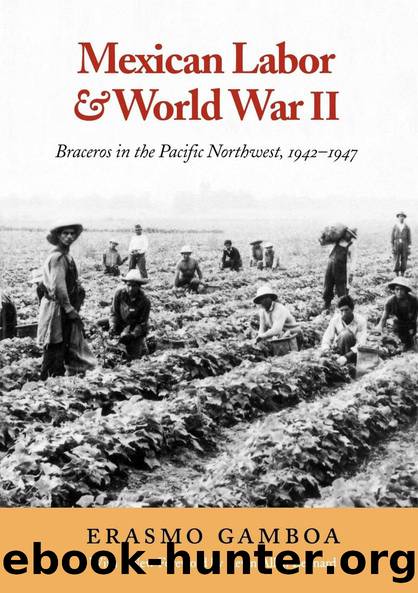
Author:Erasmo Gamboa, Kevin Leonard [Erasmo Gamboa, Kevin Leonard]
Language: eng
Format: epub
Tags: History, United States, State & Local, West (AK; CA; CO; HI; ID; MT; NV; UT; WY), Americas (North; Central; South; West Indies)
ISBN: 9780295998398
Google: WPmACgAAQBAJ
Publisher: University of Washington Press
Published: 2015-09-01T00:35:14+00:00
4. Huelgas: Bracero Strikes
NO SOONER had the Mexicans begun to arrive in the Northwest than the farmers began to disregard their contracts. This made the work experience of the great majority of the braceros only slightly better than that of servile labor. With some exceptions, farmers treated the workers so badly that their actions defied all logic and almost put an end to their very source of labor. This underscored the fact that farmers were not willing to allow foreign labor any say over employment conditions when they stubbornly withheld similar concessions to native-born workers.
Because both farmers and workers sought to maximize their gain during the war, the relationship between the two was bitter from the beginning. The farmers were displeased with the terms of PL-45 and could not understand why the United States had failed to convince Mexico to permit its workers to enter the country unconditionally. Most felt that they were saddled with an unnecessary and cumbersome contract, even though the United States was in need of labor and Mexico had a surplus.
But in reality, the farmers were needlessly concerned, because the workersâ contract did not guarantee the braceros the right to choose employers or hours and conditions of employment. Moreover, the hierarchical supervisory system, which included the growers associations, camp managers, farmers, and crew leaders on larger farms, wielded tremendous power over the workers. They transported the men to and from work, gave instructions and supervision in the fields, maintained the payroll, and, when necessary, maintained worker discipline.
The braceros, on the other hand, contracted for employment with the thought of bettering their condition of life in Mexico. They were completely powerless to make good their intention because their contract prohibited them from striking for better conditions and they were rarely asked to provide input to advisory committees or similar supportive agencies concerned with farm labor. Certainly, no Mexican worker was asked to serve on these committees, agencies, or boards. Yet, when their treatment on the job and return for their labor fell short of their aspirations and expectations, the braceros, aided by the Mexican consul, asserted themselves against their employers through strikes and protests.
Of all the problems associated with the bracero program in the Pacific Northwest, work stoppages or strikes were the most alarming to farmers. Unlike their counterparts in other parts of the country, braceros in the Northwest exhibited little reluctance to stop work. In 1944, Ernesto Galarza wrote that workers in Illinois, Colorado, New Mexico, Michigan, and California would rarely speak critically in the presence of camp managers or labor officials. He noted also that the absence of any grievance machinery to settle employment disputes left the men with but two alternativesââshut up or go back.â1 Other braceros probably staged labor protests (there was a serious disturbance near Fullerton, California, in 1943), but no general pattern of strikes emerged.2 This prevailing stereotype of braceros as docile, undemanding, and incapable of organizing themselves to press for better working conditions does not hold true in the Northwest,
Download
This site does not store any files on its server. We only index and link to content provided by other sites. Please contact the content providers to delete copyright contents if any and email us, we'll remove relevant links or contents immediately.
The Secret History by Donna Tartt(19088)
The Social Justice Warrior Handbook by Lisa De Pasquale(12190)
Thirteen Reasons Why by Jay Asher(8909)
This Is How You Lose Her by Junot Diaz(6886)
Weapons of Math Destruction by Cathy O'Neil(6279)
Zero to One by Peter Thiel(5801)
Beartown by Fredrik Backman(5754)
The Myth of the Strong Leader by Archie Brown(5507)
The Fire Next Time by James Baldwin(5444)
How Democracies Die by Steven Levitsky & Daniel Ziblatt(5218)
Promise Me, Dad by Joe Biden(5153)
Stone's Rules by Roger Stone(5087)
A Higher Loyalty: Truth, Lies, and Leadership by James Comey(4962)
100 Deadly Skills by Clint Emerson(4925)
Rise and Kill First by Ronen Bergman(4788)
Secrecy World by Jake Bernstein(4753)
The David Icke Guide to the Global Conspiracy (and how to end it) by David Icke(4717)
The Farm by Tom Rob Smith(4507)
The Doomsday Machine by Daniel Ellsberg(4490)
